Found­ations

There are a lot of opinions about what brand means and how all the pieces fit together. Here are some definitions and frameworks we've found helpful.

Frameworks

Whether you're shaping a full brand strategy or pressure-testing one piece of it, a framework can clarify how the different elements fit together and give teams a shared structure to build from.

Use them as a guide, not a rulebook! Not every project needs every piece. And follow the client's lead. For example, maybe your client came to IDEO with an established vision, mission, and values, or perhaps we're only being tasked with designing a brand's purpose—use the parts of this framework that are useful for your particular project and adapt as necessary.

Here are a few frequently used bases:

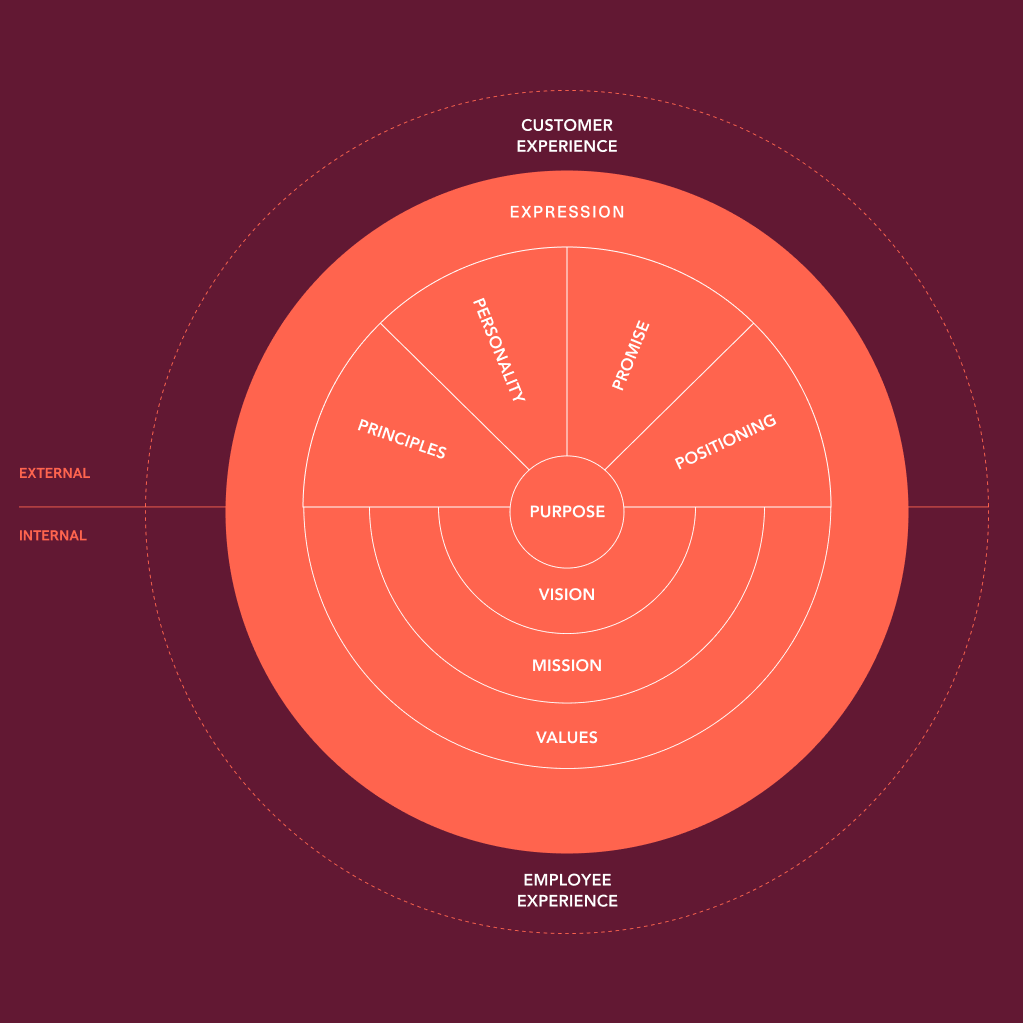
The Dartboard — concentric rings showing purpose at the center surrounded by vision, mission, values, principles, personality, promise, positioning, expression; wrapped by customer experience and employee experience.
The Dartboard
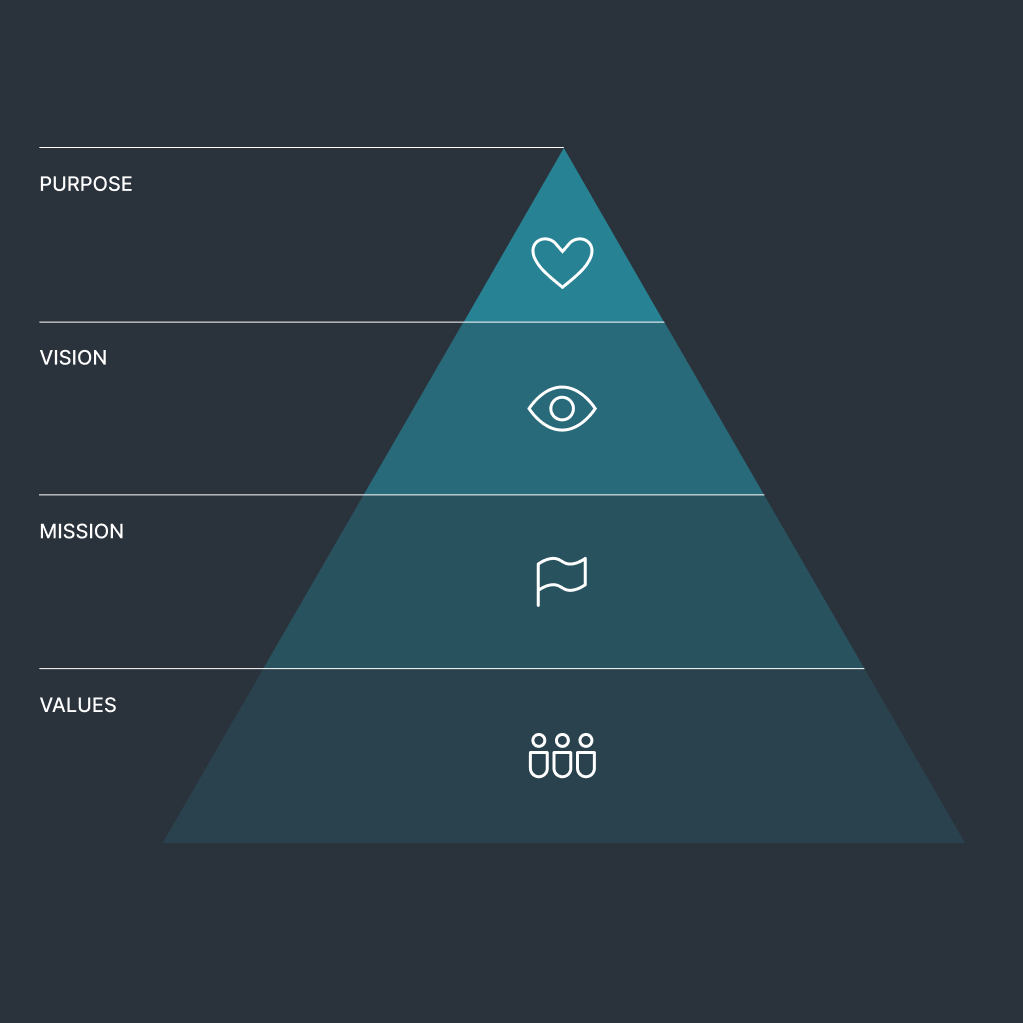
The Pyramid — four-tier framework stacking purpose, vision, mission, values.
The Pyramid
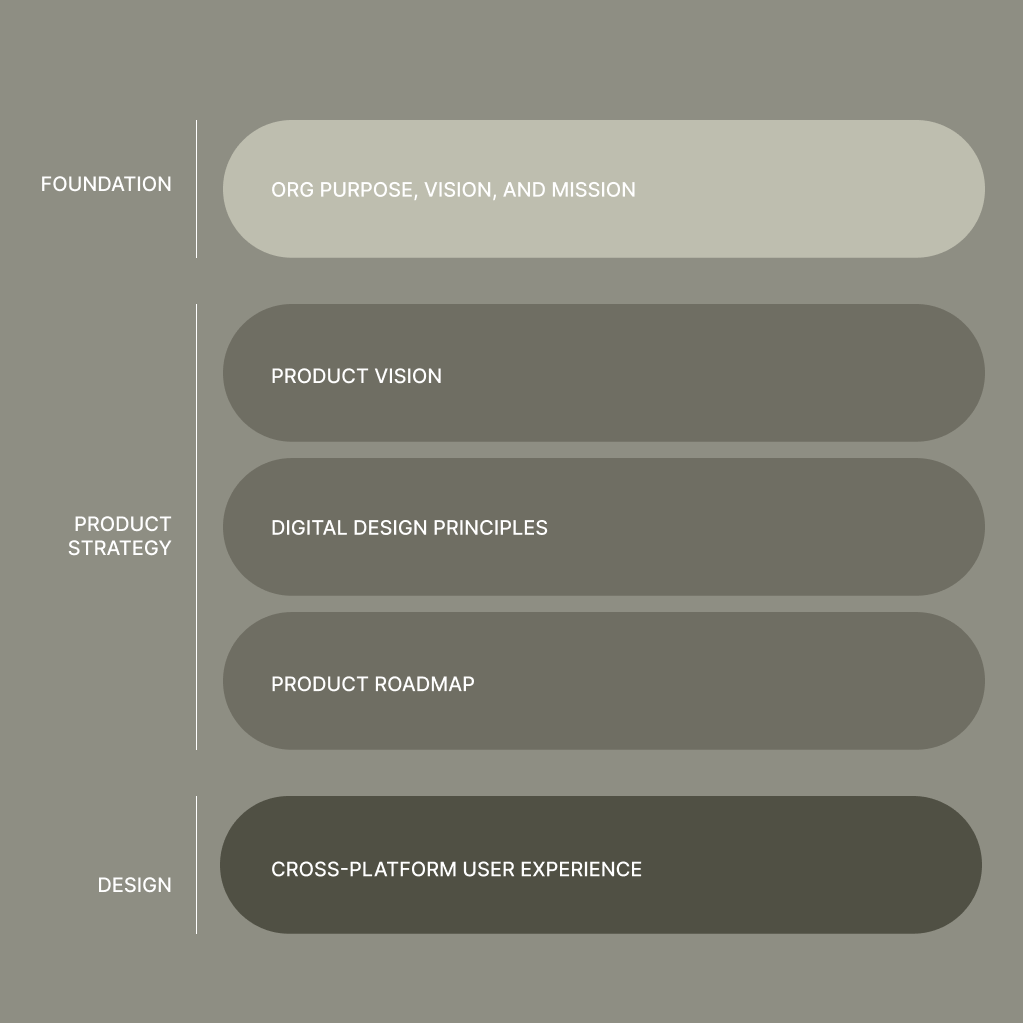
The Lasagna — foundation, product strategy, and design layered as stacked pills.
The Lasagna

Glossary

Brand terms get used in different ways, and that's where confusion starts. This glossary clarifies how we define the core elements of brand so when we say positioning, promise, or purpose, we mean the same thing.

Brand

An evolving story told through every interaction.

Brand is how your audiences experience your company and its ecosystem. Whether that audience is an end user, a business partner, or a current/prospective employee, your brand is the summation of what it feels like to interact with you across every touchpoint in your ecosystem, from products and services to marketing and communication.

Brand Strategy

The DNA of a brand.

A cohesive system of choices that defines what you stand for, how you win, and how you show up. It is grounded in who you authentically are today and aspirational about the future you intend to build.

Brand strategy includes:

  • Internal (what you stand for): purpose, vision, mission, values, architecture
  • External (how you engage with users): principles, positioning, personality, promise

A strong brand strategy translates business ambition, market realities, and audience needs into clear internal convictions and external commitments that inspire employees, align partners, sharpen decisions, and fuel business growth.

Business Strategy

The designed expression of the brand.

Business strategy defines the choices that drive growth over the next several years: where to compete, what to offer, how to make money, and what to prioritize. It translates ambition into concrete focus areas, investments, and measurable outcomes.

Unlike brand strategy, which defines meaning and differentiation, business strategy typically shows up as strategic pillars with KPIs.

Brand Identity

How the organization wins commercially.

The visual and verbal system — logo, color, typography, imagery, motion, and voice — that makes the brand recognizable and coherent across touchpoints.

Brand identity includes:

  • Visual identity (logo, colors, typography, illustration, photography, iconography, motion design)
  • Verbal identity (naming, messaging strategy, voice and tone, brand story, manifestos, tagline, elevator pitch, reasons to believe)

Brand Expression & Experience

How the brand comes to life in the real world.

The application of the brand across communications, environments, products, services, digital experiences, and even sound and smell. People come to know, understand, and connect with your brand because of its expressions.

Brand expression and experience includes:

  • Content (communication strategy, content strategy, websites and apps, packaging, print collateral, environmental graphics and wayfinding, adcepts, videos and storytelling)
  • Experiences (retail environments and services, employee programs, immersive events, digital tools, loyalty programs, AI agents, community engagement)

Brand Architecture

Structural

How is the portfolio organized?

Brand architecture defines how a company organizes and presents its portfolio of brands, sub-brands, and offerings to the market. It clarifies what stands alone, what is endorsed, and what lives under a master brand. Architecture decisions affect naming, investment, customer understanding, and long-term growth.

Common models include:

  • Branded House – One master brand across offerings (e.g., Apple, FedEx).
  • House of Brands – Independent brands with little visible connection (e.g., P&G).
  • Endorsed Brands – Sub-brands backed by a parent brand (e.g., Marriott Bonvoy).
  • Hybrid – A mix of approaches.

Purpose

Aspirational

Why do we exist?

Why we exist beyond profit; a north star. The enduring impact we aim to have on people, industries, or the world.

Vision

Directional

Where are we going?

A future-facing description of where we're headed and what success looks like if we fulfill our purpose.

Mission

Practical

What are we doing now?

The practical expression of our purpose in action. What we do, who we serve, and how we bring our purpose to life today.

Values

Fundamental

What do we believe?

Enduring beliefs that guide how we operate. They shape decisions, priorities, and expectations across the organization and shape culture. Broad and universal.

Principles

Behavioral

How do we behave?

Behavioral guardrails that translate our values into everyday actions, decisions, and interactions, ensuring our strategy comes to life consistently for customers and colleagues.

Promise

Emotional

What feeling do we commit to creating?

Distills the emotional and functional commitment our brand makes and must deliver repeatedly.

Note: Promise can influence your tagline, a short, memorable external statement that sums up your brand in a moment in time. While there are examples of taglines that stick around for a while, a tagline is not fixed and can change.

Positioning

Functional

What makes us meaningfully different?

It defines who we are for, the category we compete in, the unique value we offer, and why we are credible. In addition to audience and category definitions, positioning includes:

  • Points of Parity make brands relevant. They describe the must-haves consumers need from your brand in order to even be considered suitable for the category.
  • Points of Differentiation make brands stand out. They describe how your brand delivers on its value prop, differentiates from others, and why a consumer would choose your brand over another. AKA competitive advantage.
  • Value Proposition is an articulation of the tangible and emotional benefits we offer a defined audience. It explains who it's for, the problem we solve, and the outcome they can expect.
  • Reasons to Believe are the proof that makes our value proposition credible. These are the capabilities, evidence, or experiences that justify why people should trust us.

Personality

Expressive

What is our human character?

The multi-dimensional human traits that shape how our brand shows up in language, behavior, and emotional presence across all touchpoints.